
What You Might Not Know About Spurs
By Betty Robinson / Photography by Pat Gordon (London, Arkansas)
From the February 2004 issue of Mules and More
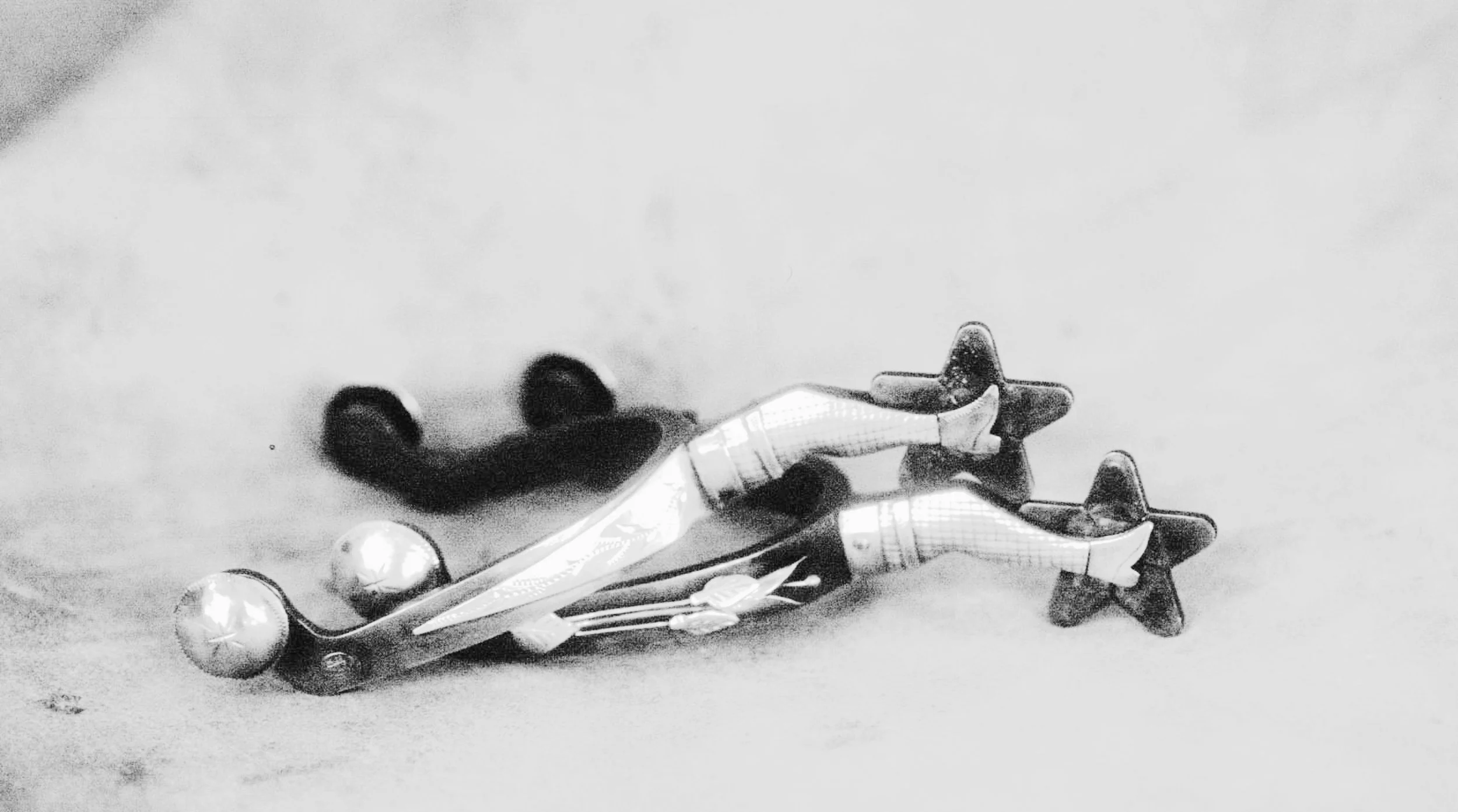
A pair of BRIGHTWELL ‘gal leg’ spurs
Close your eyes and consider this scenario.....it’s riding time. I don’t care what time of day it is, but you know it is time to get on your mule and hit the trail. You pull on your boots, strap on your spurs and head for the door. Now, here’s the catch.....did you even for one minute consider the history of those spurs you hooked on your boots? You didn’t huh? Well, you must be pretty normal, I didn’t either, until I met Rick Brightwell. But, this is what I know now.
The spur is one of the earliest essential pieces of equipment used by horsemen. History of the spur traces back so far most people don’t even want to know about it. Did you ever hear about the early stumpy prickspur found in Bohemia in the 4th century BC? These spurs were made of wood or bone with a small pointed stub attached to a heel band and were tied on with a leather thong. I have a feeling these little buggers are pretty rare, so if you happen to find any at the next collectable show, you might want to pick up a set, but expect to pay a buck or two.
Because even early horsemen saw the advantage of using a spur, this piece of equipment evolved rapidly. Material for spurs changed from wood to metal and became more sophisticated as the types of metal changed. The Conquistadors are probably responsible for bringing the spur to the New World and for originating the Vaquero design and workmanship we recognize as the ‘cowboy’ spurs today. The spur making tradition flourished in Mexico and moved north into the United States as Mexican craftsmen recognized a unique market in the American cowboy.
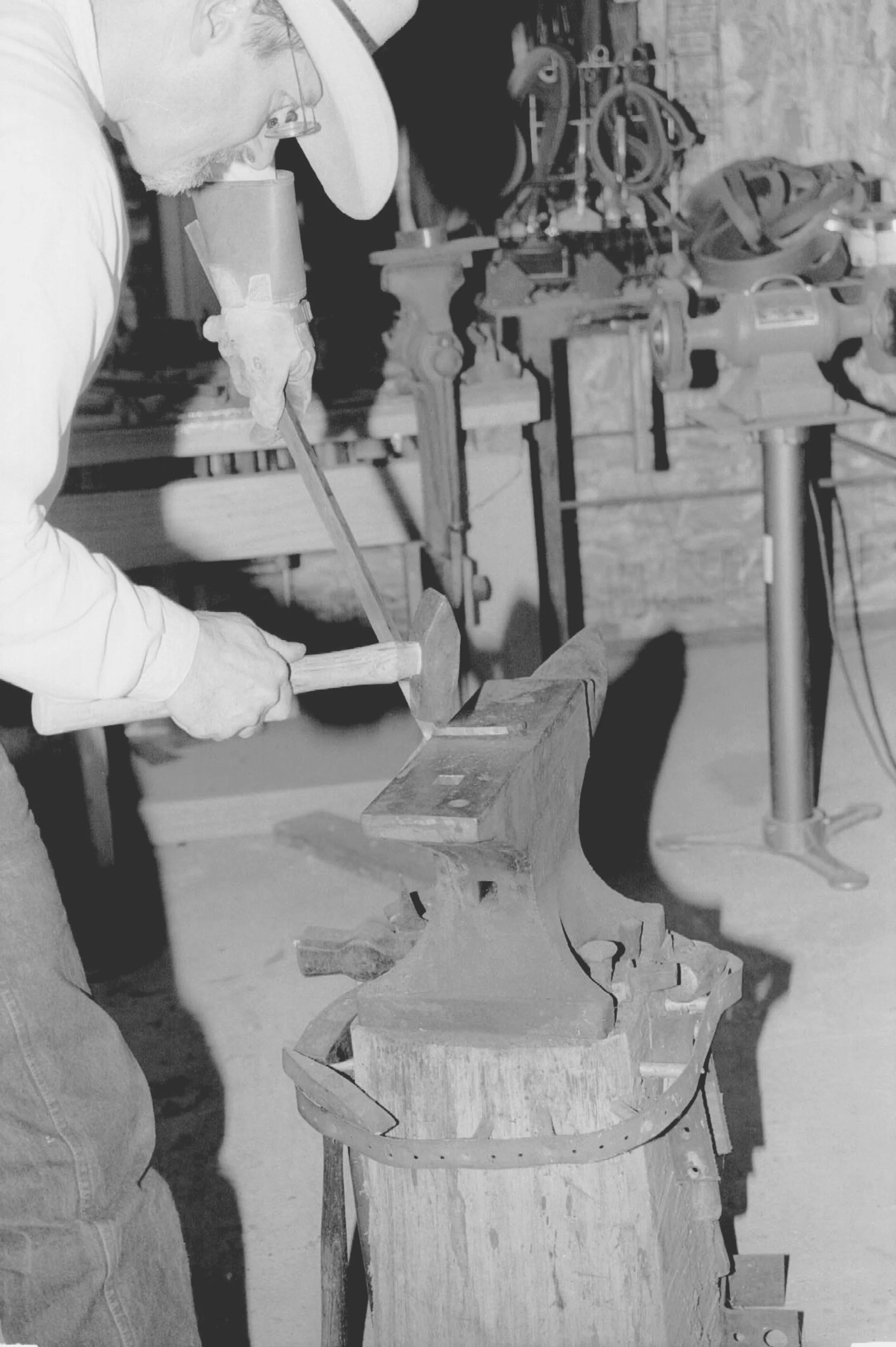
RICK BRIGHTWELL separates the single piece of steel to begin the spur making process
While the American cowboy initially wore Mexican spurs, it didn’t take long for specific styles to emerge distinguished by region. Texas-style spurs, made in Texas, Colorado, Kansas and Oklahoma were generally cruder than those made in California, Nevada and Oregon. A fancy pair of spurs among cowboys was more an exception than the rule; the fancier the spur, the fancier the price. A cowboy wore the best spur he could afford.....his spurs and his saddle made up his major fashion statement.
In the 1850’s, spur makers began to attach a small ball of finely tempered steel, so it would rattle against the long rowels. Texas cowboys christened these spurs the ‘jingle bobs’. Such spurs lightened the monotony of a day’s work riding long hours across the open prairie. These spurs also performed a truly social function. At work cowboys wore the spurs up tight and ready for action, ready to cue their horses to avoid danger or to get in the correct spot to drop a loop over a steer. But, when Saturday arrived, the spurs were dropped into the ‘town notch’.....this allowed the spurs a little drag so they would jingle on the boardwalks as the cowboy strolled down main street. Everyone enjoyed the sound and looks of a good ‘jingle bob’.
I think this admiration of a good spur remains today. Have you ever noticed all the glances you get if you forget to take off your spurs before you walk into the local super market?
I met Rick Brightwell at the Lonesome D trailhead. He was there with friends enjoying some good Dutch oven cooking and conversation around the fire. The subject of spurs came up and I discovered Rick is an artisan who makes spurs using traditional, historically correct techniques. In other words, he makes spurs the old fashion way, using only one piece of steel. Most spurs today are two pieces of metal welded together and many of them come by the boxful from China and Taiwan. This guy is a craftsman.
Rick, true to his cowboy roots, is not an arrogant man. He basically keeps his own council. I found getting information out of him is something like squeezing juice out of a rock, until the conversation turned to his passion.....traditional cowboy gear.
“My grandfather, known as Charlie ‘Tex’ Christian to most folks and known as ‘Pa’ to me,” said Rick, “was born in Arkansas, raised in Texas and homesteaded in Jackson Hole, WY in the early 1900’s. He returned to the Ozarks and put together his spread after the Snake River Land Company moved him and the other settlers out of the north end of Jackson Hole Valley in 1928. He always used the high back saddles he brought from Wyoming, while other cowboys used the modern looking saddles with low backs and Cheyenne rolls. All Pa’s gear was the real cowboy stuff. I followed him around a lot when I was young, working cows and such. I’m sure my love for the cowboy ways came straight from Granddad.”
In his 20’s Rick started making cowboy and horse gear for himself. “I wanted authentic looking period gear, 1880’s to the turn of the century,” he said. “At first it was chaps, chinks, and headstalls; then I added wooden stirrups. I mostly did the work for fun and to save myself some money, then I discovered people wanted to buy it.”
Authenticity is the name of the game for Rick. For six years he took part in Civil War reenactments, which helped him study the authenticity of the cavalry equipment. Because correct wooden stirrups were difficult to find, he started the Osage Stirrup Company and now sells authentically designed historic and military sitrrups all over the country.
Rick’s work evolved from doing leatherwork, to wooden stirrups and then to spurs and bits. “At first I took over one room of the house,” he said, “but when I started the forge work it was just too hot and dirty.”
Now he does the hot work in a little shop about 100 yards down the road and does the engraving and silver work at the shop in the house. Rick’s home is still on his grandfather’s farm in a small rural community near Compton, AR. While Rick and I were visiting a neighbor dropped by and leaned against the door jam while Rick fired up his furnace. “I guess Rick’s told you how good he is at spur making,” Gordon Keough asked. “Nope, not yet anyway,” I said.
“Didn’t figure he would,” the neighbor replied, “that’s why I dropped over. He seldom toots his own horn, but he can sell his stuff faster than he can make it. He even works on spurs while he is on his lunch hour down at the post office. Did he tell you about the new book he was published in? Ask his wife, she’ll show you a copy of it.”
I asked Rick to start at the beginning. I’ve never seen a stirrup or a spur made and this seemed like a golden opportunity I didn’t want to miss.
Rick fished a chunk of wood out of a tub filled with water from under one of his workbenches. For the next five minutes he talked to convince me that the wood was going to end up a stirrup. After looking at the molds Rick uses and listening to the explanation, I finally consented I could see how it might happen. What knowledge and skill it takes to cause that transformation!
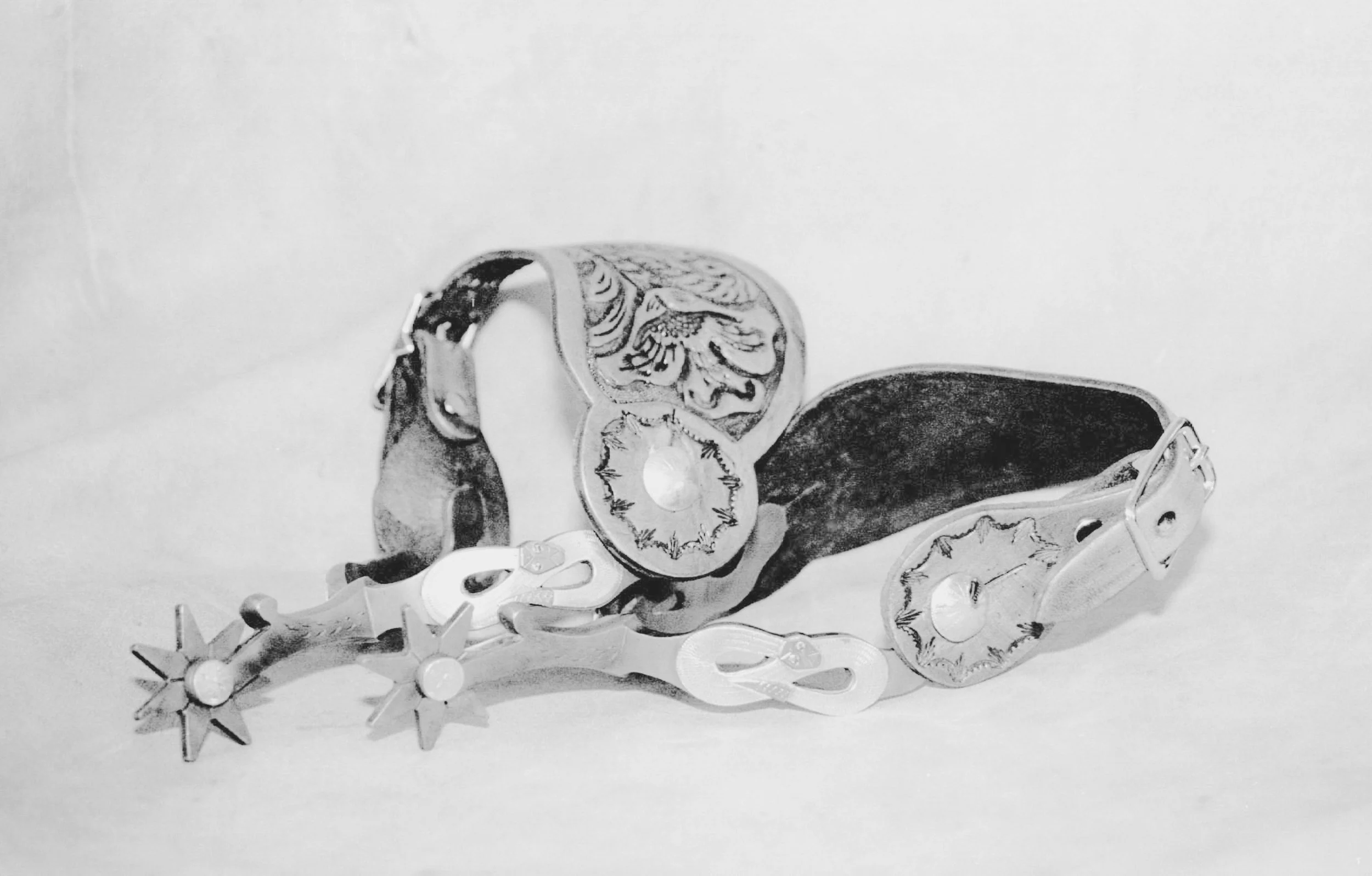
A completed pair of spurs designed and made by Brightwell
The person who had the biggest influence on Rick’s work was the late spur maker Louis Bryant of Tecumseh, OK. Louis hand forged spurs and bits, and was well into his 70’s when he finally took Rick under his wing. Rick made many trips to Tecumseh to watch, learn, and listen to Louis. At Louis Bryant’s death Rick received the original patterns for heel bands and shanks, as well as many of his tools. Rick proudly carries on the tradition.
“One of the most important assets available to today’s western gear artisans is the interaction and communication taking place between makers. Craftsmen no longer guard techniques the way they used to, much more sharing is taking place.”
Rick believes that form follows function. Form is for the person and function is for the horse or mule. The mule doesn’t care so much about the polish and shine or how much silver or gold is inlaid on the shank. They care how the bit fits in the mouth and how it functions. It is the artisan’s job to please them both.
I watch Rick tap on that white hot metal and watched a spur take shape. Not only does he forge a beautiful spur from one piece of 5/8ths inch steel, he can make one to match it for the other side. Now that’s where the trick is. Rick doesn’t take much credit for what he does. He gives credit for his training to Louis Bryant and credits Evalea, his wife, for his artistic ideas. He says she is the main contributor to the sketches and patterns he puts on his spurs. Seems to me he has a good thing going.
After we watched Rick build spurs for a while that red hot forge not only brought on a sweat it was making us all pretty thirsty. Evalea saved the day when she appeared in the door asking if we wanted some iced tea and homemade zucchini bread on the porch? We weren’t too rude, but I do think Rick may have still been looking around when the group lit a shuck up the road to the porch.
If you want to see some gorgeous spurs, drop by the Compton, Ark., post office sometime and ask for the Postmaster. Tell him Betty Robinson sent you. You won’t regret it. This guy is good. (Osage Stirrup Company, P O Box 861, Compton, AR 72624; rbright@alltel.net)