
Turning on the Haunches
by Susan Dudasik
From the April 2001 Issue
Succeeding in trail requires a lot of patience and attention to small details. At most shows, there are one or two riders who seem to stand out in the class. Usually what makes their performance different from others is having a mule that can be effortlessly positioned wherever needed. A mule must be able to move forward, backward, sideways and move its front and rear end. In the last two articles we covered turning on the forehand. Now we’re going to advance further to the turn on the haunches. But be forewarned, though many equines make a fair attempt at the turn on the haunches, doing it correctly takes time and perfecting it can take years. This maneuver is a constant work-in-progress. It’s one of the handiest moves you will teach your mule and success comes in varying degrees. The ultimate is the fast spin like those performed in reining classes, but for now we are just going to work on the simple turn on the haunches, which when correctly performed is a major accomplishment in itself .
Since you have already taught your mule to turn on his haunches from the ground, he should have a basic idea of what you want and the concept of shifting his weight from his front end to his rump. Now you need to learn how your body position will either help or hinder your mule’s ability to perform this maneuver. To understand your part in performing a turn on the haunches, try this simple exercise. Get down on your hands and knees and pretend you are the mule. Now have a friend put his hands on the center of your back and gently push down. Without moving his hands, have him lean forward. Try to move your “front-end” to one side. It’s not so easy. Now have your friend lean back, lightening the pressure on your back. As he does, shift your weight to the rear as you move your “front-end”. Feel the difference. When his weight was over your shoulders it was harder to turn since you had to lift not only your weight, but his, too, before you could move. When he was leaning back, the weight was more to your rear and it lightened up your “front-end”. This is the same thing that your mule feels. If you are tipped over his shoulders, he has a harder time moving his front end. So, you need to tip back in the saddle just a bit. It doesn’t mean that you lean so far back that you are almost laying down. Just tip slightly back.
To begin teaching the turn on the haunches you might want to use an assistant and find a safe corner to place your mule’s rump. This will help keep him from backing up instead of just shifting his weight backward. Before you try this from the saddle, review it on the ground. Ask your mule to “set back”, shift his weight to his rear, then “front over,” move his front end. Remember his body should be fairly straight, not curved in a letter “C”. Do this a few times from both sides.
When you are ready, get on your mule and have your assistant hold the reins so you aren’t tempted to try forcing him over by pulling on the reins. You should hold them in case there is a major problem, but try to let your assistant be the go-between. One major mistake riders make is trying to turn their mules with the reins. Remember, the turn on the haunches is more of a sideways motion with the mule pivoting off his hind leg, not a turn where his body follows his head around. During this maneuver, your mule’s body should be straight, not bent. If you use the reins to turn, you will be bending his head and neck while the rear end stays put.
Now, have your assistant lead your mule to the corner and back him into it. Your assistant is doing this simply to reinforce your in-hand training and it helps your mule because he is doing something he is comfortable with. Then just sit for a minute or two and relax. Some mules get nervous standing in the confines of the corner. If this happens, don’t lose your cool. Even if it takes a few days, conquer this fear first by putting him in the corner for a few seconds then walking out. Continue until he will stand quietly with his rump near the corner. When he is comfortable, start by setting yourself up. Shift your weight to the back of your saddle and while you’re doing this, have your assistant give a slight pull on the reins as you say “set back”. Your mule should start to shift his weight backwards. If he doesn’t, have your assistant press a hand against his chest until he does. Don’t be surprised if he doesn’t understand what you want. He may be doing perfect turns in hand, but this is something new. You have to start slowly, back to the beginning. Once he has shifted back, use your leg to cue him over, not the reins. Move your leg to the spot you used to cue him from the ground. This is usually somewhere in front of the cinch or as far forward as the shoulder itself. Your goal should be just a bit in front of the cinch. Push him over with your leg while telling him, “front-over”. If he resists, have your assistant PUSH him over. Only ask for one step. Stop and praise him when he steps over.
Do this two more times then have your assistant go to the other side and do it three times on that side. If all has gone well, ride your mule forward and walk him around for a few minutes and try again, one step, three times on each side. If getting just a few steps each way was a major project, quit on a good step and try again tomorrow. Don’t rush this exercise as you are trying to set a correct foundation that will be the basis of a variety of moves in the future. You want to go slow and steady. As your mule becomes comfortable with one step, ask for two and so on. You’re aiming for control, not speed.
A few major problems you might face is your unconscious need to tip forward instead of sitting back or using the reins instead of your leg and your mule’s confused desire to step backwards instead of just shifting his weight. All of these problems can be solved by time and patience. Go slowly and be happy with little accomplishments.
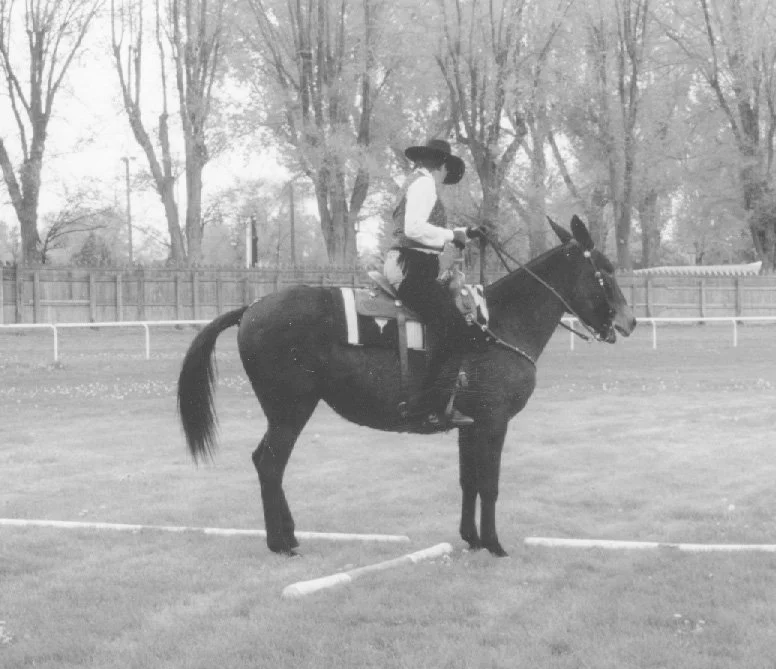
A slow, controlled turn on the haunches allows this rider to maneuver this tight three-way sidepass obstacle.
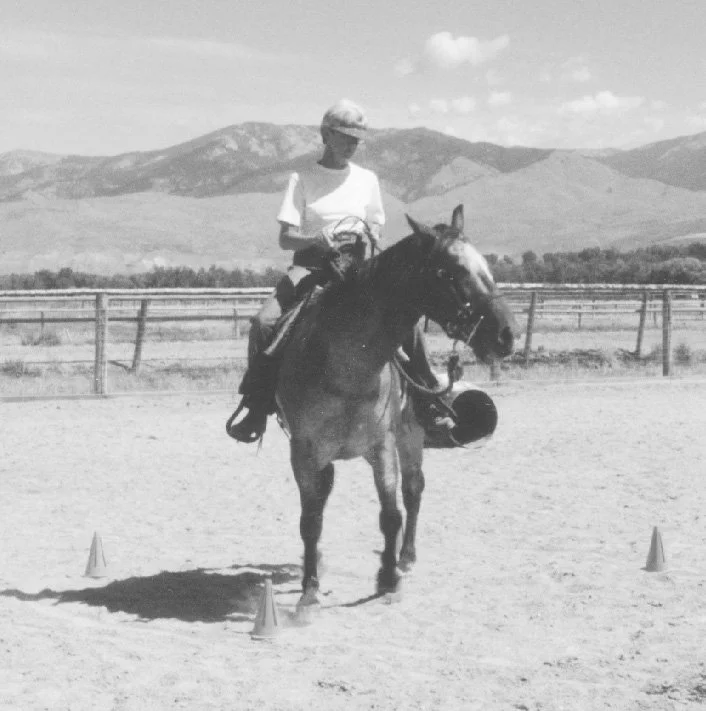
This is not a turn on the haunches.
Notice how the horse’s head is being pulled around and its right front and hind legs can be seen. This horse’s body is in the “C” position. He has no support leg to pivot on and will most likely end up using his front right leg to pivot off of.
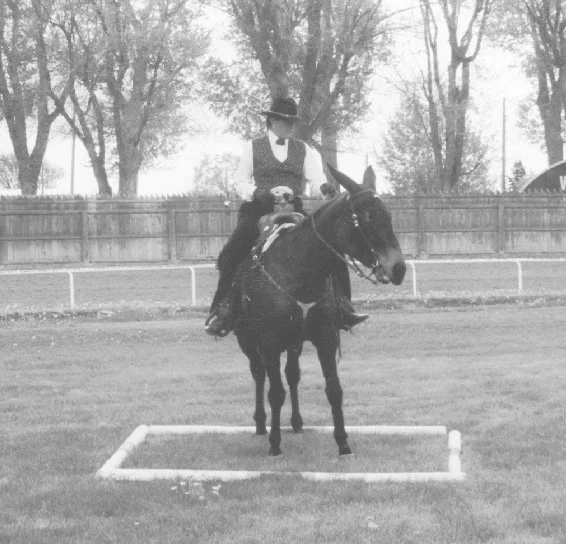
Compare this mule’s leg position to that of the horse....
The back right pivot leg is bearing the weight and though his head is tipped too far, his body is fairly straight. Also note that both riders could be hindering their equines because they are looking down at the ground which is causing their shoulder to drop and most likely they are tipping forward. Help your mule by looking up, sitting straight and setting back in the saddle.